GlucoTrust Reviews: What This Bedtime Blood Sugar Capsule Contains and What the Evidence Supports
By the Slim Herbal Formula Editorial Team · Updated October 2026
Disclosure: this article contains affiliate links. If you buy through them, we may earn a commission at no extra cost to you. It does not change what we write.
GlucoTrust at a Glance
| Form | Capsules — 30 per bottle; the sales page says one capsule a day, before bed |
| Core ingredients | 8 named: gymnema, biotin, chromium, manganese, licorice root, cinnamon, zinc, juniper berries (plus unnamed herbs) |
| Made in | Not stated on the sales page; orders ship from Ohio, USA |
| Guarantee | 60 days; bottles must be returned, return postage paid by you |
| Shipping (US) | Free on 3 and 6 bottles; the 1-bottle card shows a $9 fee — confirm at checkout |
| Main caution | Can add to the effect of insulin and other diabetes drugs; licorice is a concern with high blood pressure |
Blood sugar that creeps upward is one of the most common findings at a routine checkup after 40. Sometimes it is a fasting number a little above 100 mg/dL, sometimes an A1C in the prediabetes range, and often it comes with afternoon energy crashes and evening snacking that is hard to control. It is no surprise that supplements promising "healthy blood sugar support" sell in large numbers.
GlucoTrust is one of the longest-running products in that category. Its pitch is slightly different from most: it is a single capsule taken at bedtime, and the brand ties it to sleep quality and cravings as well as glucose. In this review we look at what the official site actually lists, how much of the marketing the research supports, which ingredients deserve caution (especially if you already take diabetes medication), and what the price, shipping and refund terms say in practice.
→ See the full GlucoTrust ingredient list on the official website
What Is GlucoTrust?
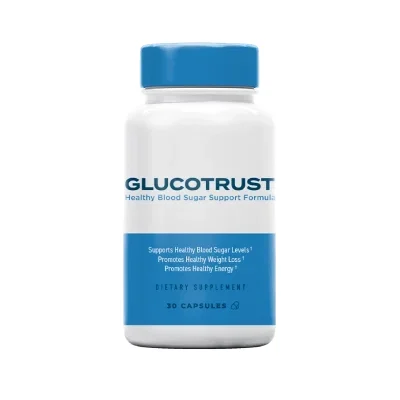
GlucoTrust is a dietary supplement sold in bottles of 30 capsules. The sales page recommends one capsule a day with water, taken before you go to sleep, so each bottle is meant to last about a month. It is marketed for healthy blood sugar levels, healthy blood flow, fewer sugar and junk-food cravings, and deeper sleep, and the bottle label adds weight and energy support.
The product is sold online through its own website. The support pages name Adem Naturals in Tallmadge, Ohio, as the address orders ship from and returns go to. What the sales page does not state is where the capsules are manufactured or whether the facility is registered with the FDA or certified for Good Manufacturing Practices. Many competitors put that information up front; here it is simply missing, so if it matters to you, ask customer support before ordering.
One more point that applies to every product in this category: dietary supplements are not reviewed by the FDA for effectiveness before they are sold. The site's own terms say its claims have not been evaluated by the FDA and that the product is not intended to diagnose, treat, cure or prevent any disease. Keep that in mind when you read lines about "restoring" healthy blood sugar.
How GlucoTrust Is Said to Work: Claim vs Evidence
The sales letter makes three linked claims. First, that a mix of herbs and minerals helps your body handle glucose. Second, that the capsule's sleep-supporting ingredients deepen sleep, which keeps cortisol in check and supports leptin, the hormone involved in fullness. Third, that better sleep plus fewer cravings makes weight loss easier.
The idea that sleep affects blood sugar is not invented. Research on sleep restriction has repeatedly shown that short or poor-quality sleep makes the body less sensitive to insulin, and people who sleep badly tend to eat more. That part of the story is reasonable. The weak link is the next step: there is no published study of GlucoTrust itself, the sleep ingredients are not named, and none of the doses are disclosed. So the mechanism is plausible in general terms, but there is no way to show that this particular capsule delivers it.
The more useful question is whether the named ingredients have any human evidence at doses we can compare. The next section takes them one at a time.
GlucoTrust Ingredients and What the Research Says
The sales page names eight ingredients and then mentions "several sleep-enhancing ingredients" and a blend of 15 herbs without listing them. No amounts are given in the page text. That is common in this market, but it means none of the studies below can be matched to what is actually in a capsule.
1. Gymnema Sylvestre
Gymnema is a climbing plant used in Ayurvedic medicine, sometimes called "sugar destroyer" because chewing the leaf briefly blunts the taste of sweetness. Small human studies, several of them older and from India, have reported lower fasting glucose and A1C in people with type 2 diabetes taking a gymnema leaf extract alongside their usual treatment. These trials were small and not always well controlled, and no major US health body recommends gymnema for glucose control. There are also rare case reports of liver injury linked to gymnema, so it is not a completely risk-free herb.
2. Biotin
Biotin (vitamin B7) helps enzymes that process carbohydrates, fats and protein. True biotin deficiency is rare, and there is no solid evidence that extra biotin lowers blood sugar in people who already get enough. Its main practical issue is safety-related rather than benefit-related: high-dose biotin can distort the results of some blood tests, a point covered in the safety section.
3. Chromium
Chromium is a trace mineral that appears to help insulin do its job, which is why it shows up in almost every blood sugar formula. The evidence is inconsistent. Some trials and meta-analyses have found small reductions in fasting glucose in people with type 2 diabetes, while others found no meaningful effect, and a 2016 review in Nutrition Reviews concluded that the evidence for chromium in glycemic control is limited. The NIH Office of Dietary Supplements notes that chromium may increase the risk of low blood sugar when combined with diabetes medication.
4. Manganese
Manganese is an essential mineral used by several enzymes, including some involved in glucose metabolism. The sales page says it stimulates insulin production, but that has not been shown in people taking manganese supplements. Most adults get enough from whole grains, nuts, legumes and tea, and the NIH sets an upper limit of 11 mg a day because excess manganese can affect the nervous system.
5. Licorice Root
Licorice has a long history in traditional medicine, and some of its flavonoids have been studied in the lab for metabolic effects. Human evidence for blood sugar is thin. What is well documented is its main downside: glycyrrhizin, the compound that gives licorice its sweetness, can raise blood pressure and lower potassium when consumed regularly. GlucoTrust does not say how much licorice each capsule contains or whether it is a deglycyrrhizinated (DGL) form, which is the single biggest gap in the label for anyone with heart or blood pressure concerns.
6. Cinnamon
Cinnamon is probably the most-studied spice for blood sugar. A 2013 meta-analysis in the Annals of Family Medicine found modest drops in fasting glucose but no clear change in A1C, and the NCCIH describes the overall results as hard to interpret. The type matters too: cassia cinnamon contains coumarin, which can harm the liver in large amounts, while Ceylon cinnamon contains very little. The sales page does not say which type it uses.
7. Zinc
Zinc is needed for insulin to be stored and released by the pancreas, and people with diabetes sometimes have lower zinc levels. Some trials have reported small improvements in glucose markers with zinc supplements, mostly in people who were low to begin with. If your diet already covers your needs, extra zinc is unlikely to add much, and long-term high doses can lower copper levels.
8. Juniper Berries
Juniper berries are best known as the flavor of gin. They contain antioxidant compounds, and some animal studies have looked at effects on glucose, but there is no meaningful human research on juniper for blood sugar. Juniper is traditionally avoided during pregnancy and by people with kidney problems.
The Unnamed Sleep Ingredients and Herbal Blend
The sales page refers to sleep-enhancing ingredients and a 15-herb blend but does not name them. Earlier versions of the formula have been described elsewhere with different extras, so we cannot confirm what the current bottle contains. If you want the full list before buying, the most reliable source is the Supplement Facts panel on the bottle itself, which you can request from support.
Prefer a single capsule at night over drops or several pills a day? Check GlucoTrust's current packages on the official site.
Visit the Official GlucoTrust Website →Pros and Cons of GlucoTrust
Pros
- Simple routine: one capsule a day, taken at bedtime
- Includes ingredients that have at least some human research for glucose (chromium, cinnamon, gymnema, zinc)
- One-time purchase on the sales page; no subscription is mentioned
- Free US shipping on the 3- and 6-bottle packages
- 60-day money-back guarantee with a published return address and phone number
Cons
- No ingredient doses are disclosed on the sales page
- Part of the formula (sleep ingredients and herbal blend) is not named
- Licorice root is included with no amount or form stated
- Manufacturing location and facility standards are not stated
- Broad marketing claims, from weight loss to hair and eyesight, go well beyond the evidence
- Return postage is paid by the customer
Who Might Consider GlucoTrust (and Who Should Not)
GlucoTrust is aimed at adults who:
- have been told their fasting glucose or A1C is at the high end of normal and want to add a supplement to diet and activity changes
- prefer one capsule a day and like taking it at night
- have normal blood pressure, normal kidney function and no heart condition
- are not on insulin or other glucose-lowering medication, or have their doctor's go-ahead if they are
You should skip it, or speak to your doctor first, if you:
- take insulin, metformin, a sulfonylurea (such as glipizide or glyburide) or any other diabetes medicine
- have high blood pressure, heart disease, kidney disease or low potassium (because of the licorice)
- take diuretics, blood pressure medicines, digoxin or corticosteroids
- have liver disease
- are pregnant, breastfeeding or under 18
- have blood tests coming up (because of the biotin)
A supplement is not a substitute for diagnosis or treatment. If you have symptoms such as constant thirst, frequent urination, blurred vision or unexplained weight loss, get your blood sugar checked properly rather than starting a supplement.
Safety, Side Effects and Diabetes Medication Cautions
No serious side effects have been publicly reported for GlucoTrust as a finished product, and most of its named ingredients are well tolerated in the amounts used in food and typical supplements. Mild stomach upset is the most common complaint with this kind of formula. The real risks come from specific ingredients and from combining them with prescription drugs.
Low Blood Sugar With Diabetes Medication
This is the most important caution. Chromium, gymnema and cinnamon are all included because they may nudge glucose down. If you already take insulin or a drug that pushes the pancreas to release insulin, such as a sulfonylurea, adding them could push your levels too low. Signs of hypoglycemia include shakiness, sweating, a racing heart, confusion and sudden hunger. Do not stop or reduce any diabetes medicine on your own because you started a supplement. If your doctor agrees you can try it, check your glucose more often during the first weeks and report any lows.
Licorice and Blood Pressure
Regular intake of glycyrrhizin can cause the body to hold on to sodium and lose potassium, which may raise blood pressure and, in rare cases, cause an irregular heartbeat. The NCCIH notes that the risk is higher for people with high blood pressure, heart or kidney disease, and that licorice can interact with diuretics, corticosteroids, digoxin and some other drugs. Because GlucoTrust does not publish its licorice dose, anyone in these groups should treat the product with caution.
Biotin and Lab Tests
The FDA has warned that biotin can cause falsely high or falsely low results on some lab tests, including thyroid tests and troponin, a marker used to detect heart attacks. Tell your doctor and the lab that you take a product containing biotin, and ask whether you should pause it before blood work.
Other Points
If the cinnamon is the cassia type, very high long-term intake may stress the liver, and gymnema has rare reports of liver injury, so people with liver disease should ask a doctor first. Juniper is best avoided in pregnancy and by people with kidney problems.
How to Use GlucoTrust
The official instructions are simple: one capsule a day with a glass of water, before bed. Do not take more than the label recommends. If you want to judge it fairly, start with a baseline: a recent fasting glucose or A1C result, or a week of home meter readings if you already test. Keep your diet and activity steady, take the capsule at the same time every night, and recheck the same numbers after six to eight weeks, which still leaves time to use the 60-day guarantee if you see no change.
Supplements of this kind are, at best, a small addition to the measures with the strongest evidence: losing a modest amount of weight if you are overweight, regular physical activity, fewer refined carbohydrates and sugary drinks, and adequate sleep.
GlucoTrust Price, Shipping and Guarantee
GlucoTrust is sold in three packages on the official site. At the time of writing, the order cards showed the following prices:
| Package | Price shown on the official site |
|---|---|
| 1 bottle (30-day supply) | $69 per bottle + $9 shipping fee |
| 3 bottles (90-day supply) | $59 per bottle — $177 total, free US shipping |
| 6 bottles (180-day supply) | $49 per bottle — $294 total, free US shipping |
| Bonuses | Three digital guides (smoothie recipes, superfoods, liver cleanse) with multi-bottle orders |
| Guarantee | 60-day money-back policy |
| International shipping | $19.95 to Canada, UK, Ireland, Australia, NZ and South Africa; 10 to 15 working days |
Two details are worth flagging. The site's shipping-terms page lists US delivery as free, while the single-bottle order card shows a $9 fee and an exit pop-up mentions a discounted single bottle with a $9.99 fee. Prices and fees can change between page versions, so confirm the final total at checkout. US orders are listed at about 5 to 7 working days, with a tracking email within 60 hours.
→ Check today's GlucoTrust price and packages on the official website
What We Saw on the Official GlucoTrust Order Page (October 12, 2026)
On October 12, 2026 we opened the official order page ourselves and followed the checkout up to the payment step, without placing an order, to record exactly what a buyer sees. The screenshots below are unedited crops from that visit.

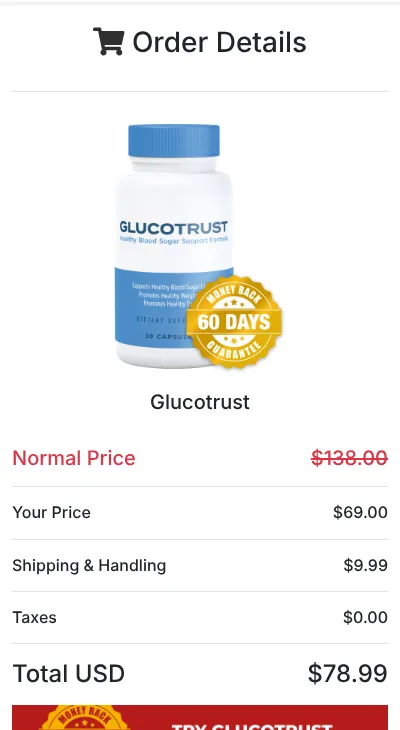
- The order page offered 1 bottle at $69, 3 bottles at $59 per bottle ($177) and 6 bottles at $49 per bottle ($294); the 3- and 6-bottle bundles showed free US shipping.
- Under the 1-bottle option the order page said “+ $9 Shipping Fee”, but the checkout we reached showed $69.00 plus $9.99 shipping and handling, $78.99 total. A small difference, but it is a reminder to read the final total, not the product page.
- The 3-bottle checkout came to $177.00 and the 6-bottle checkout to $294.00, both with $0.00 shipping.
- The refund policy page describes a 60-day, 100% money-back policy, and the contact page lists support@getglucotrust.com.
Refunds and Complaints: What the Policy Actually Says
The guarantee is 60 days. (The sales page also calls this "six full months", which is clearly an error; the refund policy page and terms both say 60 days.) To request a refund you contact support by email, phone or the refund form on the site. The policy states that the product has to be returned before the refund is issued, that the customer pays the return postage, and that you can alternatively refuse the package at delivery so it goes back to the sender.
Most complaints about products like this one concern the refund process rather than the capsules: shipping not being refunded, returns arriving after the window, or confusion about where to send bottles. You can avoid most of that by keeping your order confirmation and tracking number, asking support for a return authorization in writing, and shipping the bottles back with tracking well before day 60.
GlucoTrust vs Other Blood Sugar Supplements
Most competing formulas use the same core group of ingredients: chromium, cinnamon, gymnema, berberine, bitter melon or alpha-lipoic acid. GlucoTrust's distinguishing features are the bedtime timing, the inclusion of licorice and juniper, and the sleep angle. Products built around berberine have stronger trial data for glucose than most herbs, but berberine also interacts with many medicines. Drop formulas often contain caffeine-bearing herbs such as guarana, which a bedtime capsule avoids. Whatever you compare, the questions are the same: are all ingredients named, are doses published, and how do the refund terms work?
Where to Buy GlucoTrust
GlucoTrust is sold through its official website, and the guarantee described above applies to orders placed there. Listings on marketplaces or unknown stores may be old stock, imitations or resellers that are not covered by the 60-day policy, so ordering from the official page is the safest way to get the genuine product and the refund terms.
Final Verdict
GlucoTrust is an easy product to use: one capsule at night, a clear 60-day guarantee and no subscription mentioned on the sales page. Its named ingredients include a few with modest human research for glucose, mainly chromium, cinnamon and gymnema, alongside minerals and botanicals whose role is mostly theoretical.
The drawbacks are real. Doses are not published, part of the formula is unnamed, the manufacturing details are missing, and licorice is a genuine concern for people with high blood pressure or heart and kidney conditions. Most importantly, anyone taking insulin or other diabetes medication should only try it with their doctor's agreement and closer glucose monitoring. If you are healthy apart from borderline readings, are willing to track your numbers for about two months, and keep realistic expectations, GlucoTrust is a reasonable product to try under its guarantee. It can support healthy habits; it cannot replace them, or medical care.
Frequently Asked Questions (FAQs)
Is GlucoTrust FDA-approved?
No dietary supplement is FDA-approved. The GlucoTrust site's terms state that its claims have not been evaluated by the FDA, and the sales page does not say where or in what kind of facility the capsules are made.
Can I take GlucoTrust with metformin or insulin?
Only with your doctor's approval. Chromium, gymnema and cinnamon may lower blood sugar, which could add to the effect of insulin, sulfonylureas and other diabetes drugs and raise the risk of low blood sugar. Never change your medication on your own.
How long does GlucoTrust take to work?
The brand does not give a specific timeline. Studies on its better-known ingredients typically lasted 6 to 12 weeks, so recheck your numbers after about two months, which still fits inside the 60-day guarantee.
Does GlucoTrust have side effects?
No serious side effects have been publicly reported for the product. The main concerns are licorice (blood pressure and potassium), biotin (interference with lab tests) and the risk of low blood sugar when combined with diabetes medication.
Is GlucoTrust a subscription?
The sales page presents it as a one-time purchase of 1, 3 or 6 bottles and does not mention automatic rebilling. Check the order summary before you pay.
How do I get a refund?
Contact support within 60 days by email, phone or the site's refund form, then return the bottles to the address they give you. Return postage is paid by you, so use a tracked service.
Want to compare the current GlucoTrust packages? The official site lists today's prices.
Visit the Official GlucoTrust Website →References
- NIH Office of Dietary Supplements. Chromium — Fact Sheet for Health Professionals.
- Costello RB, et al. Chromium supplements for glycemic control in type 2 diabetes: limited evidence of effectiveness. Nutr Rev. 2016;74(7):455-468.
- Allen RW, et al. Cinnamon use in type 2 diabetes: an updated systematic review and meta-analysis. Ann Fam Med. 2013;11(5):452-459.
- Baskaran K, et al. Antidiabetic effect of a leaf extract from Gymnema sylvestre in non-insulin-dependent diabetes mellitus patients. J Ethnopharmacol. 1990;30(3):295-300.
- Shiyovich A, et al. Toxic hepatitis induced by Gymnema sylvestre, a natural remedy for type 2 diabetes mellitus. Am J Med Sci. 2010;340(6):514-517.
- National Center for Complementary and Integrative Health (NCCIH). Licorice Root.
- National Center for Complementary and Integrative Health (NCCIH). Cinnamon.
- NIH Office of Dietary Supplements. Biotin — Fact Sheet for Health Professionals.
- U.S. Food and Drug Administration. The FDA Warns that Biotin May Interfere with Lab Tests: FDA Safety Communication (2017, updated 2019).
- NIH Office of Dietary Supplements. Zinc — Fact Sheet for Health Professionals.
- NIH Office of Dietary Supplements. Manganese — Fact Sheet for Health Professionals.
- American Diabetes Association. Standards of Care in Diabetes. Diabetes Care (annual supplement).
This review is for general information only and is not medical advice. Product details (ingredients, prices, guarantee) come from the official GlucoTrust pages as checked in October 2026; they can change, so confirm them at checkout. Talk to your doctor before starting any supplement, especially if you take prescription medication or have a health condition.